


Park Seismic LLC, Shelton, Connecticut, Tel: 347-860-1223, Fax: 203-513-2056, Email: contact@parkseismic.com
1-D and 2-D Shear-Velocity (Vs) Profiling
Various types of surveys can be taken depending on the thoroughness of the site
characterization being sought. If only the overall vertical (depth) variation of stiffness
information is needed, then a 1-D Vs profiling is sufficient (Fig. 1). If the lateral variation
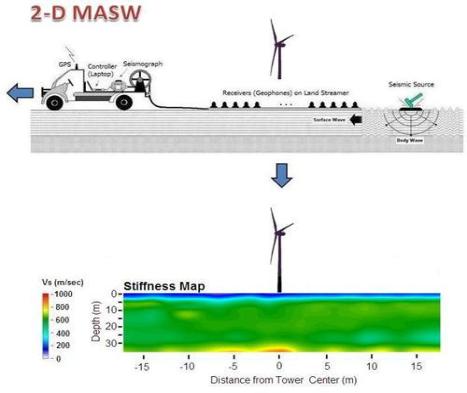
information is also important, a 2-D profiling can be conducted along a certain direction
(Fig. 2). Considering that the minimum field operational cost for the 1-D profiling is
usually more than half the cost for a 2-D profiling, a 2-D profiling is usually the
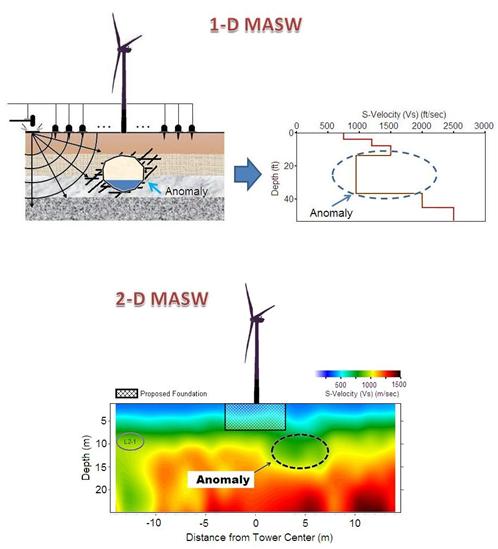
recommended minimum approach. An anomaly—defined as a localized area
significantly different in elastic property (strength and density) than ambient material—
can be delineated through either 1-D or 2-D profiling if its size (dimension) is significant
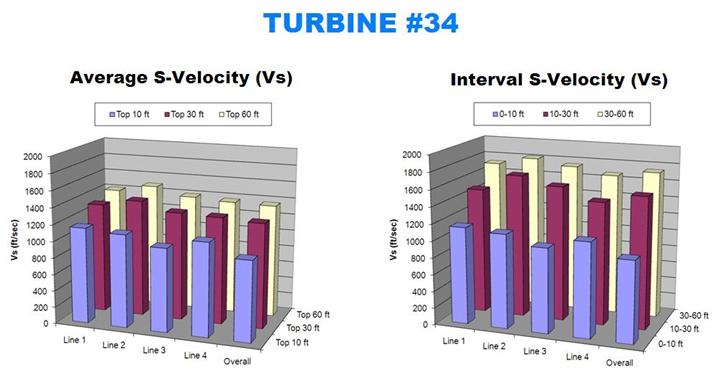
(for example, greater than 20% of its depth) (Fig. 3). Average and interval shear
velocities are also provided as by-products for each 1-D or 2-D profiling survey (Fig. 4).
Various types of surveys can be taken depending on the thoroughness of the site
characterization being sought. If only the overall vertical (depth) variation of stiffness
information is needed, then a 1-D Vs profiling is sufficient (Fig. 1). If the lateral variation
information is also important, a 2-D profiling can be conducted along a certain direction
(Fig. 2). Considering that the minimum field operational cost for the 1-D profiling is
usually more than half the cost for a 2-D profiling, a 2-D profiling is usually the
recommended minimum approach. An anomaly—defined as a localized area
significantly different in elastic property (strength and density) than ambient material—
can be delineated through either 1-D or 2-D profiling if its size (dimension) is significant
(for example, greater than 20% of its depth) (Fig. 3). Average and interval shear
velocities are also provided as by-products for each 1-D or 2-D profiling survey (Fig. 4).
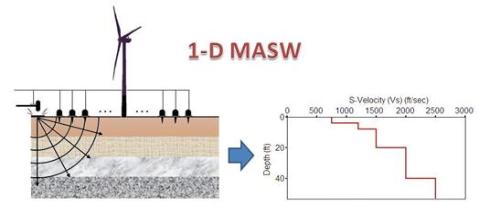
| Fig. 1. Typical 1-D MASW survey and its 1-D shear-wave velocity (Vs) profile. |
(Above) Fig. 2. Typical 2-D MASW survey and its 2-D shear-wave velocity (Vs) map.
(Right) Fig. 3. Anomaly detection by 1-D (illustration) and 2-D (field data) surveys.
(Below) Fig. 4. Display of average and interval shear-wave velocities at a site.
(Right) Fig. 3. Anomaly detection by 1-D (illustration) and 2-D (field data) surveys.
(Below) Fig. 4. Display of average and interval shear-wave velocities at a site.
 | |  | |  | |  | |  | |  | |  | |  | |  |